
February 24 marks four years since Russia’s full-scale invasion of Ukraine.
For millions of people, daily life is still shaped by displacement, damaged infrastructure, and ongoing insecurity. The humanitarian crisis has not ended, but it has become prolonged—and, for older people, increasingly severe.
Older People Bearing a Disproportionate Share of the Impact
According to the United Nations, 10.8 million people in Ukraine will require humanitarian assistance this year, including 4.2 million in immediate, life-saving need. Nearly 9.6 million people remain displaced.
Older people represent roughly a quarter of Ukraine’s population, yet they account for half of civilian deaths and one-third of reported injuries.
More than half of Ukrainians over 70 now live alone. Many are managing chronic illness or disability in a context where transportation and health services remain unstable.
Despite these increased risks, only about one-third of older people are currently reached by humanitarian assistance.
Four years into the war, isolation, poverty, and psychological strain continue to compound the crisis.
HelpAge's Response
Since February 2022, HelpAge and our global network partners have worked across Ukraine to ensure older people are not left out of the humanitarian response.
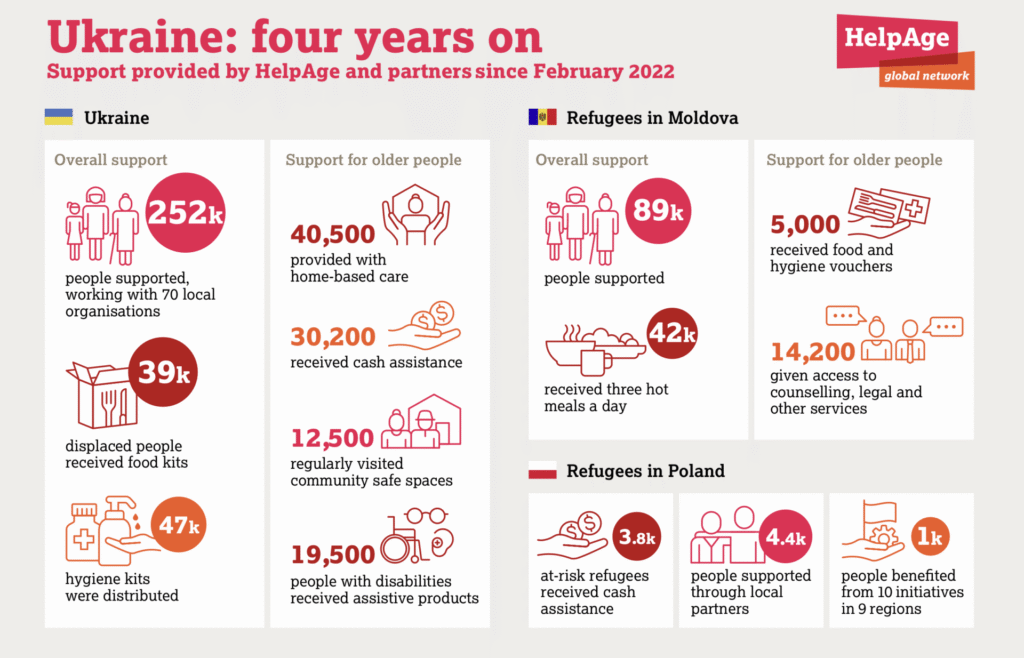
Together, we have supported more than 252,000 people, including:
- 40,500 older people receiving home-based care
- 30,200 people receiving cash assistance
- 19,500 people with disabilities receiving assistive products
- 12,500 older people regularly participating in Community Safe Spaces
Across Moldova and Poland, HelpAge and partners have also supported older refugees with food, hygiene supplies, cash assistance, counseling, and other essential services to ensure no one has to face these challenges alone.
Community Safe Spaces: Rebuilding Connection
For many older people, the war has meant not only displacement and loss, but increased isolation.
Across eight Community Safe Spaces in Ukraine supported by HelpAge USA, Peer-to-Peer groups bring together small communities of older people to check on one another and share their experiences.
For 87-year-old Olha, displaced from the Donetsk region, receiving regular visits from a Peer-to-Peer counselor has meant she no longer spends her days in silence.
In a country where more than half of people over 70 live alone, consistent human connection can shape whether someone remains visible to services or disappears from view.
Lives Behind the Numbers
Valentyna, 66, spent 42 days sheltering in her building in Sievierodonetsk as bombardments shook the city. When a shell struck, her windows and doors blew out and gas filled the house. She refused to leave without her dog: “She is like a member of my family,” she says.

Now displaced, she weaves traditional Ukrainian necklaces and sews adaptive clothing for people injured in the war. Her participation in her local Community Safe Space has helped her rebuild connection and routine.
“I find incredible peace and joy in creating.”
Four Years of War
The crisis is no longer new, but it remains urgent.
As funding tightens and global attention shifts, older people risk becoming further sidelined in humanitarian response plans. Yet, they remain among the most affected and the last to be reached.
On this four-year mark, we reaffirm a simple commitment: older people must not be overlooked, in this war or its ongoing recovery.